
AI-Enhanced
Baby Registry
Strategic AI Integration for High-Stakes Decisions
Completed as final capstone project for Master UX Design for AI (Maven, 2025)
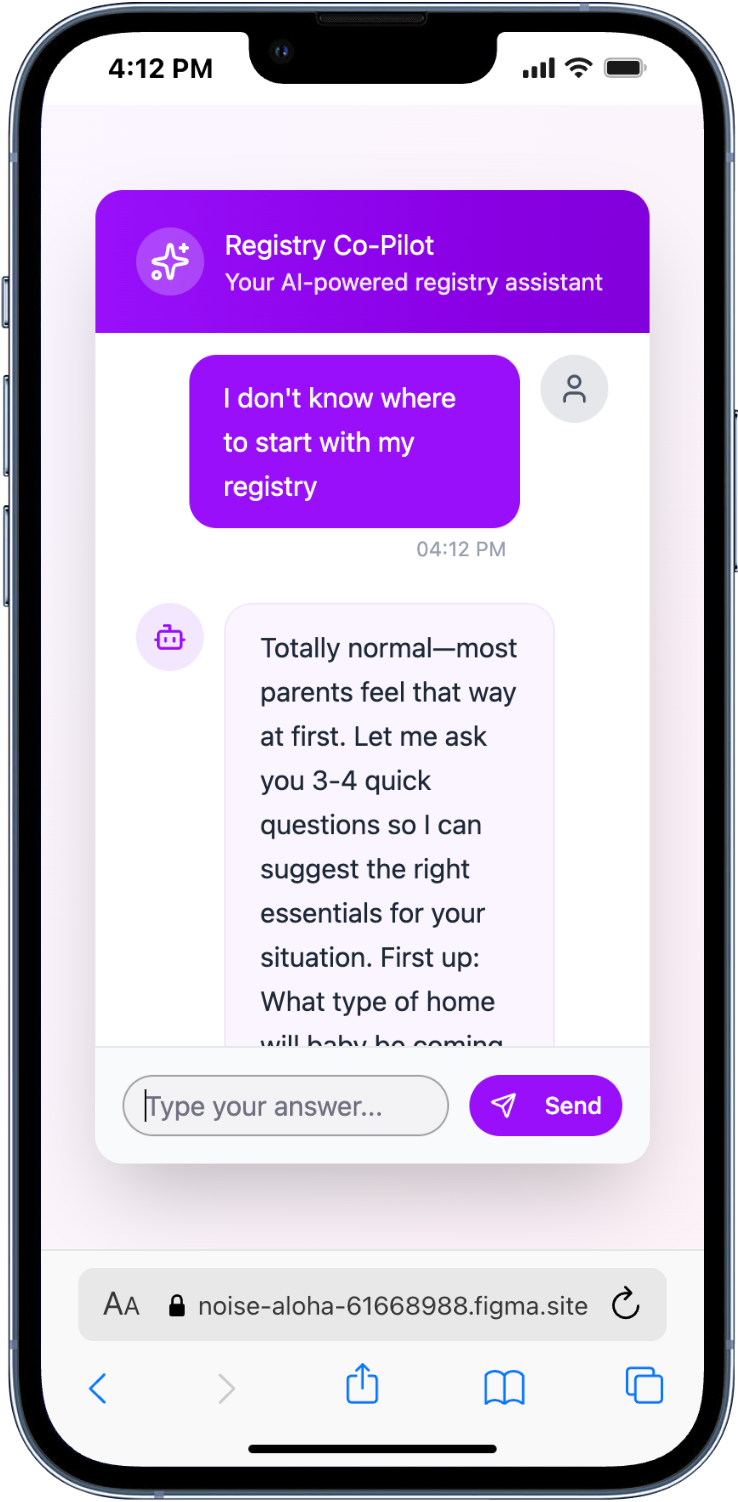


Parents creating a baby registry face a uniquely complex problem: decision paralysis under high stakes.
They're navigating:
Thousands of product options with minimal differentiation
Contradictory advice from friends, family, blogs, and reviews
Fear of making the "wrong" choice when their child's safety and comfort are at stake
Time pressure (registries need to be completed before the baby arrives)
Analysis paralysis—they can spend 2-3 hours researching a single product category
The root cause isn't missing information. It's cognitive overload from too much information without context.
This is where AI seemed like an obvious solution. But I wanted to approach it strategically, not reactively. The question wasn't "Where can we add AI?" It was "Where does AI actually reduce friction and build trust?"
The Challenge
My Approach
Rather than designing AI features first and then mapping them to user needs, I worked backward: identify high-friction moments, then evaluate whether AI would help.
-
I created a framework to evaluate each phase of the registry journey:
Strategy Check:
Should we proceed with this AI integration?
Does it solve a real problem?
Is this a moment where users expect and welcome AI assistance?
Does it align with our brand as a trusted, editorial authority?
-
Initiation & Structuring (Registry Setup): YES — Users welcome help eliminating blank-page anxiety
Discovery & Validation (Product Research): YES — Users need help synthesizing overwhelming information
Finalization & Socialization (Registry Review): CAREFUL — Users want human control here because it's personal and social
-
Reduced abandonment in setup
Reduced time spent on product research
Increased registry completion rate
Higher user confidence in their final selections
This framework prevented the trap of "add AI everywhere." Instead, it created strategic focus.
-
I mapped the 3-phase registry journey with success probabilities and AI interventions:
Phase 1 — Initiation & Structuring (85% success): User sets up registry with AI-generated starter list
Phase 2 — Discovery & Validation (95% success): User researches products with AI-summarized reviews and safety alerts
Phase 3 — Finalization & Socialization (80% success): User completes registry with AI-run health checks, then invites family
Notice the success probabilities are HIGH because I'm placing AI strategically at moments where it reduces friction without automating away user choice.
The Solution
-
Principle 1: Simplify, Don't Synthesize
The AI summary isn't a paragraph. It's exactly 3 bullet points—never more.
Why? Research shows anxious parents experience decision paralysis with more than 3 data points. Counterintuitively, MORE information decreases confidence.
Example: Instead of showing a full review section with 47 reviews averaging 4.3 stars, the AI surfaces:
"Durable & long-lasting (mentioned in 34% of reviews)"
"Easier to clean than comparable models"
"⚠️ Safety note: Check car seat compatibility before purchasing"
This is progressive disclosure—show what matters most, then let users click for more if they need it.
Before: Content-heavy homepage with cluttered navigation, unclear commerce pathways, inconsistent visual language across sections
After: Clean, intentional information architecture with three clear entry points (Pregnancy, Newborn & Baby, Toddler) that guided users to both content and commerce naturally
-
Principle 2: Contextualize for Confidence
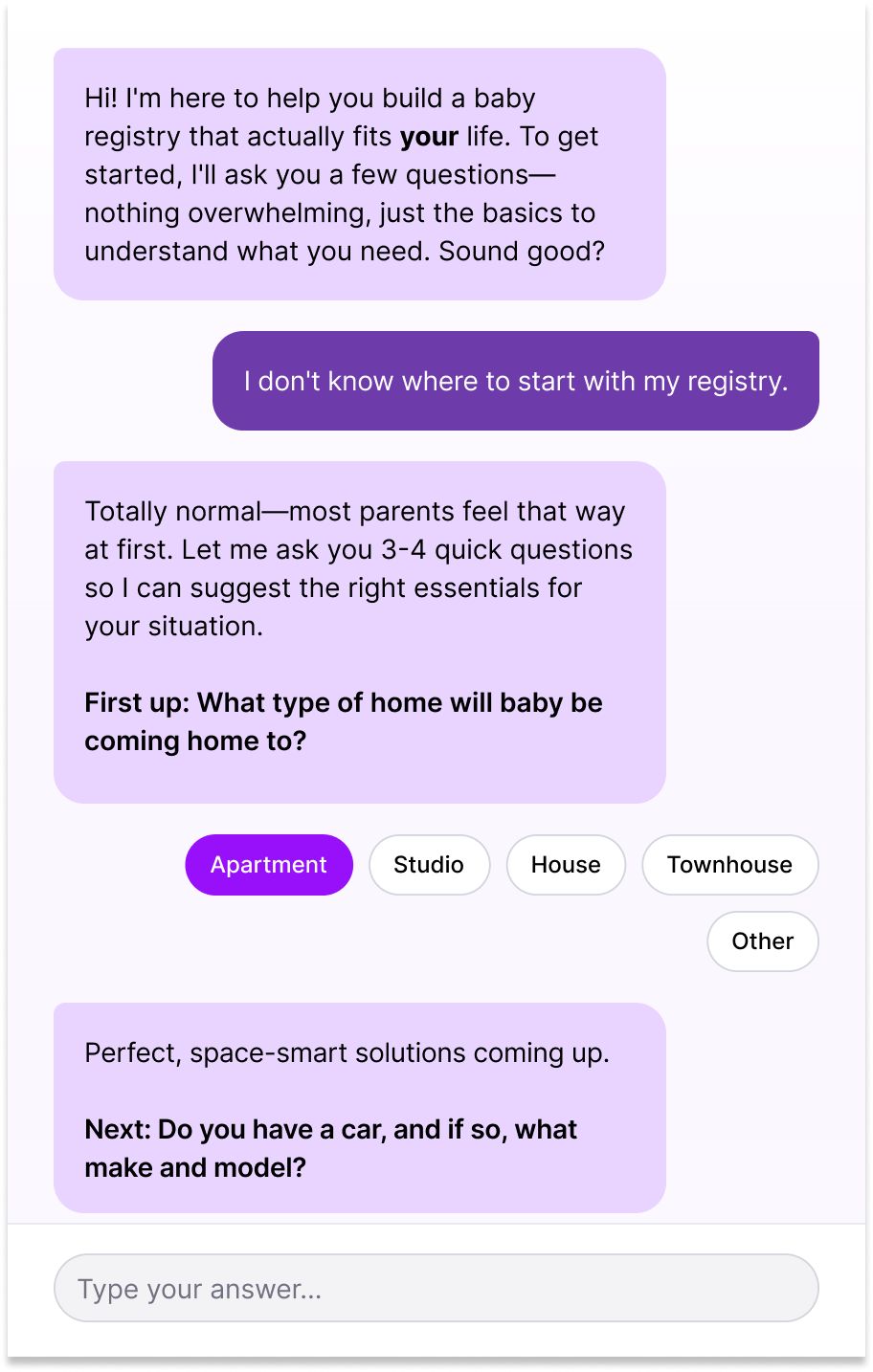
The AI doesn't give generic recommendations. It understands context through a conversational setup flow:
"Where do you live?" (apartment vs. house affects furniture size)
"Do you have a car?" (impacts car seat and stroller needs)
"Due date?" (timing-based product phases)
Every recommendation then shows the WHY: "Recommended because you have an apartment and need space-efficient solutions."
This contextualization transforms generic checklists into personalized guidance that users trust because they see the logic.
-
Principle 3: Augment, Never Automate
The AI suggests, the user decides. Every single product requires explicit user approval. Nothing auto-adds to the registry.
This was critical because user research showed 70% of expectant parents want human control over product selections—especially anything touching baby safety. The AI is a co-pilot, not an autopilot.
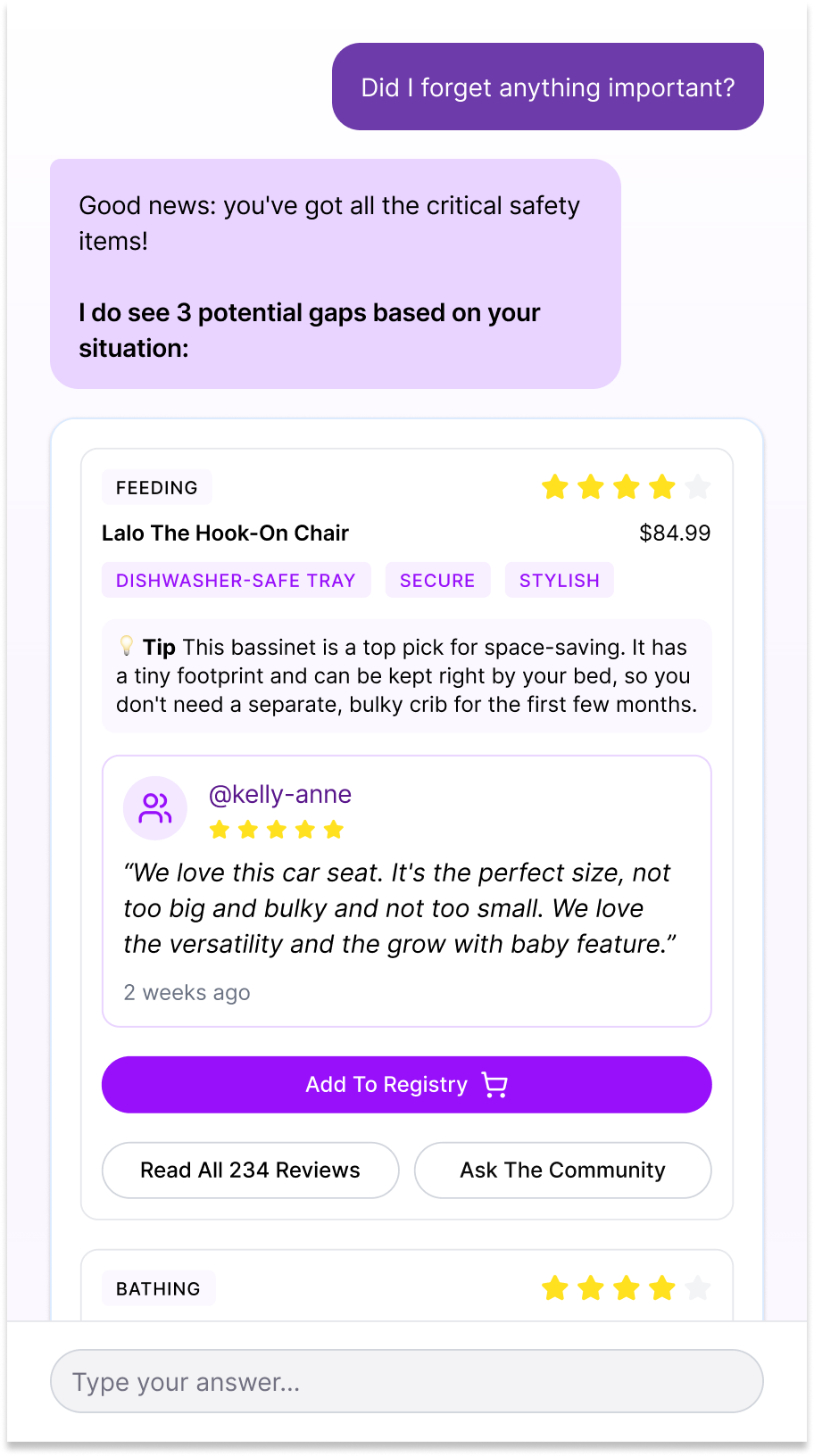
For example, the "Registry Health Check" AI identifies gaps:
"Missing car seat recommendation"
"No diaper size coverage for months 6-12"
But it doesn't auto-add anything. Instead, it surfaces these gaps and the user chooses what to do. This maintains autonomy while reducing decision fatigue.
Implementation Details
*
Implementation Details *
-
The AI asks 4 contextual questions through a conversational interface. Based on responses, it generates a starter registry with products pre-categorized:
Nursery furniture (sized for apartment vs. house)
Transportation (car seat + stroller adapted to user's stated needs)
Feeding/diapering supplies
Clothing (sized for due date)
This eliminates the blank-page problem. Users start with a foundation they can then customize, not a terrifying empty list.
Success metric: Reduction in registry setup abandonment (currently 12-15%)
-
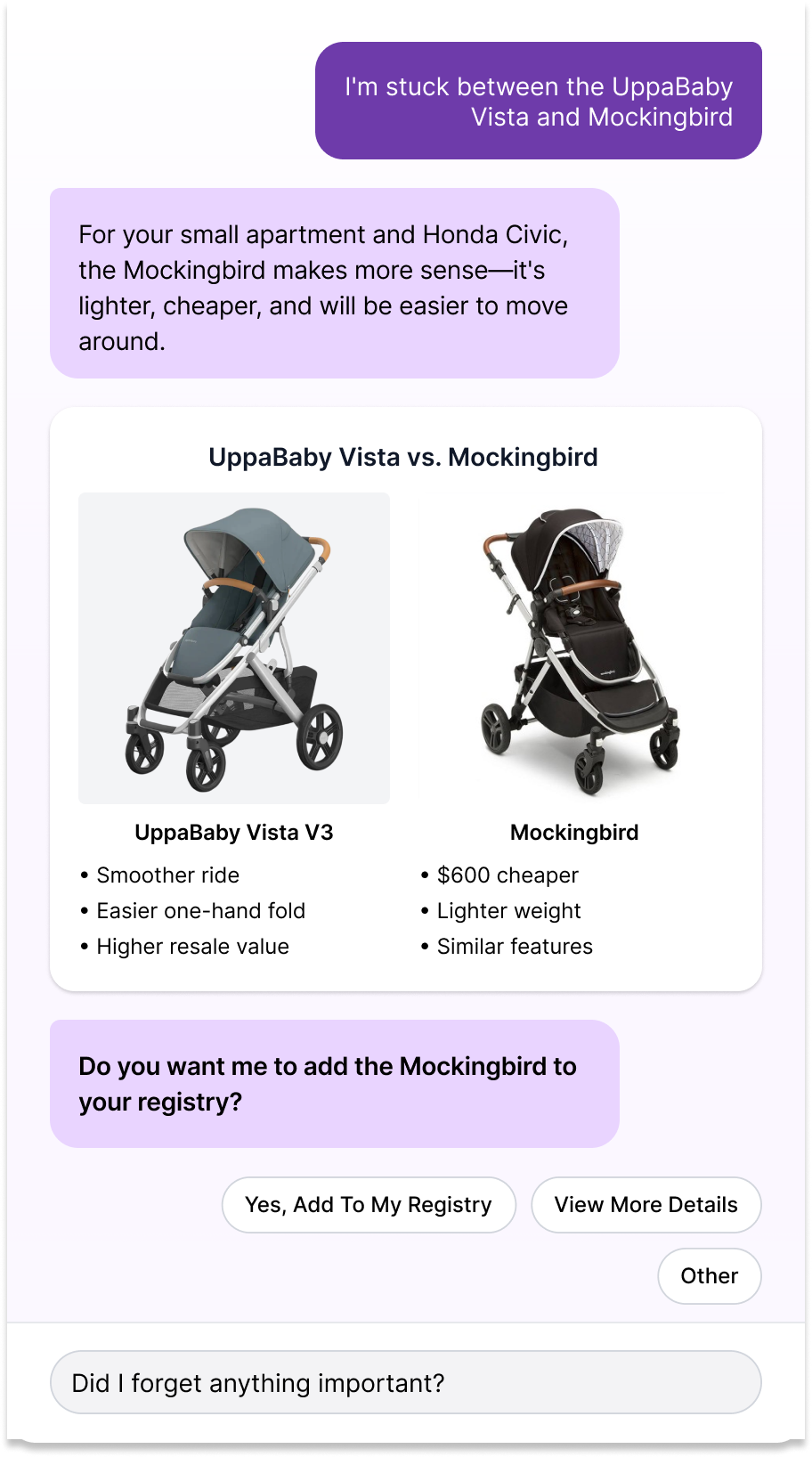
When users research individual products, the AI provides:
3-bullet summary of reviews (what parents actually care about)
Safety alerts flagged from product recalls or common issues
"Comparison similar items" suggestions (reducing decision paralysis about which stroller to choose)
Links to relevant Bump editorial (reinforcing our authority while driving product discovery)
Success metric: Reduction in time spent per product (currently averaging 8-12 minutes per item researched)
-
Before the registry goes live, the AI runs a check against best-practice baby registries:
Product coverage across essential categories
Price distribution (avoiding over/under-investment in categories)
Duplicate product detection
Gaps (missing car seat, missing diaper supplies for certain age ranges)
The AI surfaces these findings with suggestions, but the user retains full control. They can accept suggestions, dismiss them, or modify them.
Success metric: Higher registry completion rate and better coverage distribution
The highest-impact interventions aren't where AI is most technically impressive. They're where AI directly reduces cognitive load at moments of decision paralysis.
Placing AI in Phases 1 & 2 (setup and discovery) yields 95%+ success rates. Placing AI in Phase 3 (finalization) only works when it respects user autonomy—otherwise it erodes trust.
Transparency Builds Trust
Every AI recommendation shows the reasoning behind it. "This product is recommended because you live in an apartment and need space-efficient furniture." Users don't need to understand how the AI works—they need to see why the AI recommends what it does.
User Control is Non-Negotiable
The moment AI automates a decision away from the user (especially in high-stakes domains like baby safety), trust evaporates. The AI must augment human judgment, never replace it.
Context-Aware Design Reduces Cognitive Load More Than Data Aggregation
A thoughtfully filtered list of 5 products is more valuable than comprehensive access to 500 products. Smart filtering beats more information.
This project taught me three principles about designing with emerging technology:
Technology serves strategy, not the reverse — Start with the user problem and business opportunity. Then ask: "Is AI the right tool for this moment?" Often it isn't.
Principles govern execution — "Simplify, Contextualize, Augment" became decision-making criteria. When the engineering team proposed auto-adding registry items, we could reference these principles to say no. Principles create consistency.
High-stakes domains demand different design — In healthcare, safety, or parenting contexts, user autonomy isn't negotiable. Designing for trust means designing for control. This is fundamentally different from designing entertainment or social media, where algorithmic recommendations can be more prescriptive.